
Muscle matters more than the scale — here’s how our team actually moves

At West Holistic. fitness conversations usually start with labwork. Before we talk about workouts or body composition, we want to understand what’s happening hormonally, metabolically, and nutritionally.
Labs give us the baseline — they help explain why someone feels exhausted despite “doing everything right,” or why progress has stalled even with a solid routine.
Body composition is the next layer. And it tells a very different story than the scale does.
What the scale doesn't tell you
Two people can weigh exactly the same and have completely different metabolic health. One might have strong muscle mass and low visceral fat; the other might have the opposite. The scale reads the same. Their energy, their risk factors, and their long-term trajectory don’t.
Muscle mass is one of the most underappreciated markers of long-term health. It helps regulate blood sugar, supports hormone balance, protects bone density, and keeps metabolism functioning well.
And starting in your 30s, it naturally begins to decline — slowly, quietly.
"You can lose muscle while your weight stays perfectly still. That's why we look beyond the number."
Research suggests most adults lose somewhere between 3–8% of muscle mass per decade after 30 — a process called sarcopenia — and it accelerates without intentional support.
This is where tools like the Evolt 360 body composition scan come in, not as a replacement for labs, but as a complement.
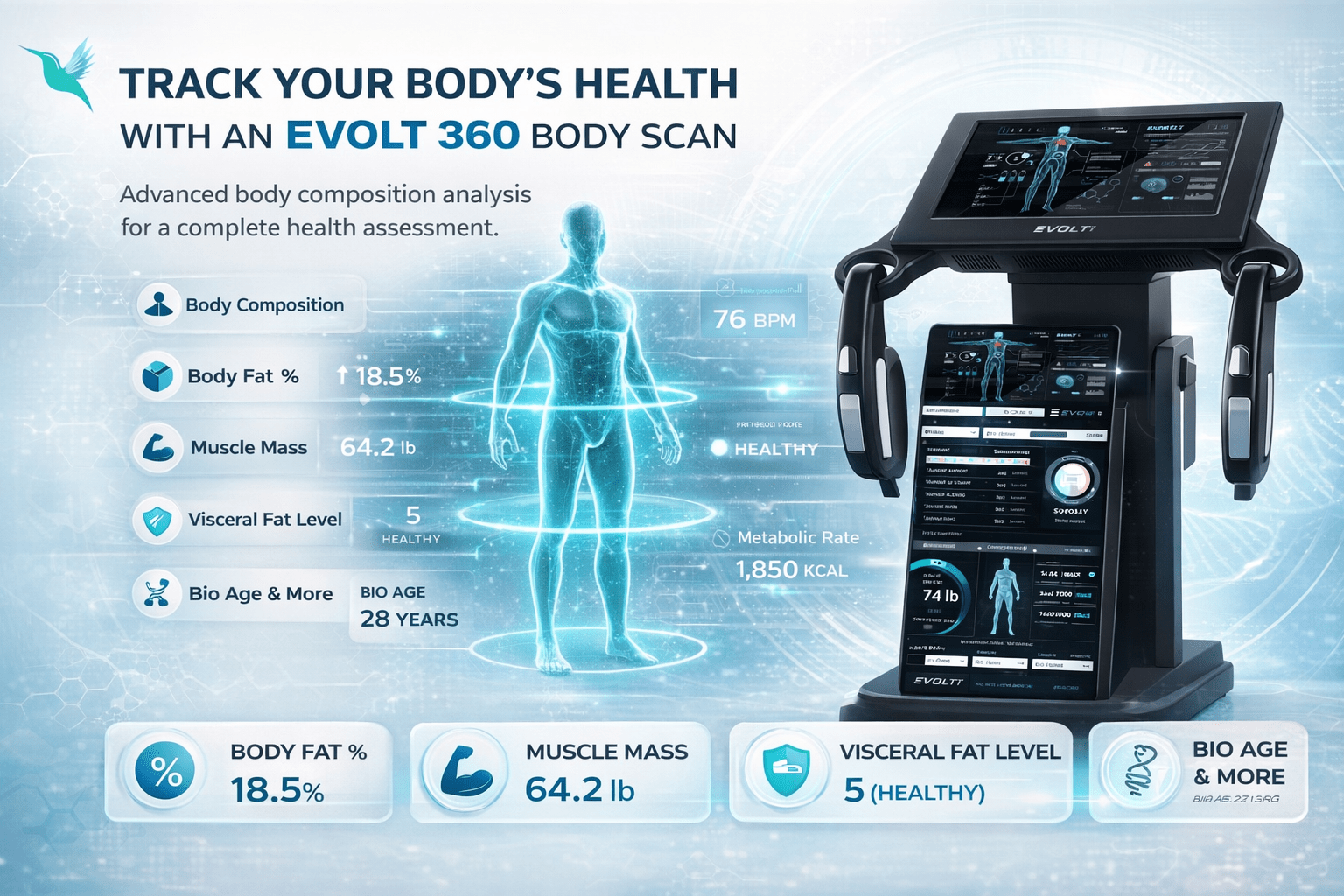
Together, they give us a much fuller picture of what’s actually going on and what kind of support your body needs.
How Our Team Moves
Once you start looking beyond the scale, the question shifts from “what’s the perfect workout?” to “what can I actually sustain?” Here’s what that looks like for our team.
Dr. Maltz leans into variety. Some days it’s Zumba or dancing, other days it’s a walk outside, yoga, or a strength class. For her, mixing things up keeps movement from feeling like a chore—and that’s what keeps it consistent.
Dr. Afridi has kept a simple practice for over 20 years—something called the Five Tibetan Rites. It’s a short daily sequence she returns to because it supports her energy, her mood, and her nervous system without needing to overcomplicate things. Outside of that, she gravitates toward movement that feels good: rebounding, hiking, swimming, yoga. Her rule is simple—if you enjoy it, you’ll keep doing it.
Kitty, FNP-C, builds movement into her day in a really practical way. She walks daily, practices yoga, and incorporates strength training one to two times per week to support her hormones and blood sugar. She also looks for small opportunities to move more—parking farther away, walking between errands, letting it add up naturally.
Our Front Desk Receptionist, Maida, has found her rhythm with early morning CrossFit. What keeps her coming back isn’t just the workout—it’s the community and how she feels afterward. She focuses less on how she looks and more on showing up, even on the mornings when she really doesn’t feel like it. And more often than not, she’s glad she did.
As our Integrative Nutrition Health Coach, my movement practice is always evolving. Daily walks and weekly yoga are my foundation, with a mix of strength training and Pilates woven in throughout the week. I also sync my workouts with my cycle, adjusting intensity based on what my body actually needs. Mobility, fascia support, and lymphatic movement are a big part of my routine too, especially for supporting my autoimmune health.
Why This Matters Long-Term
None of these routines look the same—and they’re not meant to.
What stands out isn’t intensity or perfection. It’s consistency. Choosing movement that feels supportive enough to come back to, again and again. Over time, that’s what actually protects muscle.
Ready to look beyond the scale?
Book an Evolt scan or schedule a visit with our team—we’ll walk through your results together.

 Or call
Share this article